

Self-managed superannuation funds have evolved from niche retirement planning structures to mainstream wealth-building vehicles embraced by hundreds of thousands of Australians seeking greater control over their retirement savings. The ability to borrow within SMSFs for property acquisition represents one of the most powerful yet complex strategies available, enabling trustees to leverage superannuation capital acquiring investment properties that might otherwise remain out of reach.
However, the regulatory framework governing SMSF borrowing creates obligations, constraints, and risks that distinguish these arrangements fundamentally from conventional property investment. Success demands understanding not just opportunity but also complexity, recognizing both strategic advantages and potential pitfalls that could compromise retirement security if approached carelessly. Smart investors master the intricacies of SMSF property lending before committing capital, ensuring their strategies align with regulatory requirements while genuinely enhancing long-term wealth rather than creating expensive problems.
Understanding Limited Recourse Borrowing Arrangements
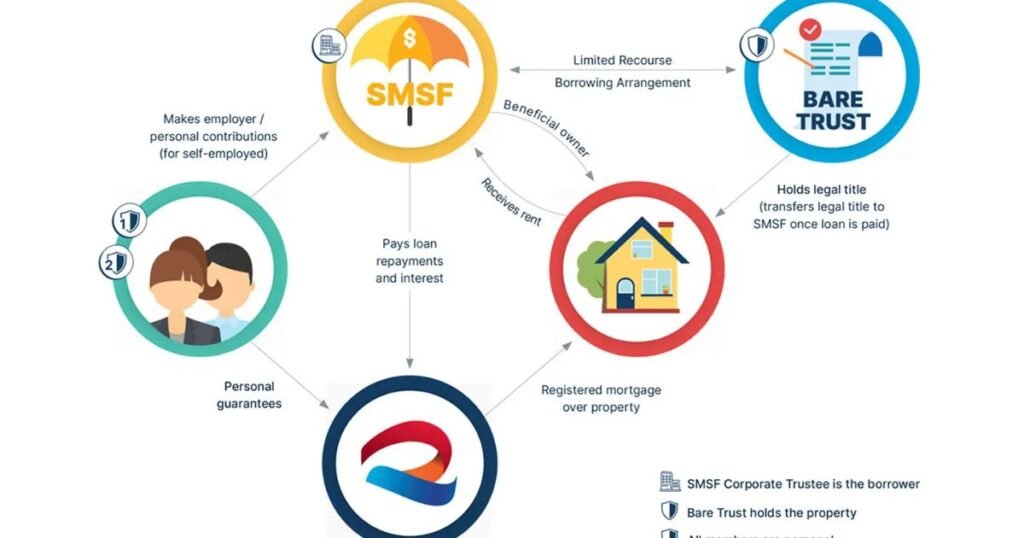
SMSF borrowing operates through limited recourse borrowing arrangements—specialized structures designed to protect superannuation funds while enabling property acquisition with leverage.
The bare trust structure separates legal ownership from beneficial ownership, with properties held in bare trusts while SMSFs make loan repayments and eventually acquire full legal title upon debt repayment. This separation ensures lenders’ recourse limits to specific mortgaged properties rather than extending to other fund assets, protecting members’ broader retirement savings from property-specific risks.
Single acquirable asset rules require each borrowing arrangement to relate to single assets or collections of identical assets, preventing SMSFs from borrowing against property portfolios or using cross-collateralization that conventional property investors might employ. This constraint affects portfolio building strategies, requiring separate loans for each property and limiting leverage optimization techniques available outside superannuation.
Replacement asset provisions allow SMSFs to replace properties with equivalent assets under certain circumstances, though restrictions prevent upgrades or improvements fundamentally changing asset characteristics. Understanding these limitations prevents compliance violations that could result in severe penalties including fund disqualification.
Member guarantees prohibition prevents SMSF members from personally guaranteeing fund loans, eliminating the fallback options that conventional lending commonly employs. This restriction reinforces limited recourse nature while requiring properties and fund positions to stand on their own merits without external support.

Strategic Advantages of SMSF Property Investment
Despite complexity, SMSF Loans offer compelling advantages for wealth accumulation that make mastering the framework worthwhile for qualified investors.
Concessional tax treatment within superannuation dramatically improves investment returns compared to holding property personally. Rental income taxed at 15% during accumulation phase and 0% in pension phase creates substantial tax advantages, while capital gains tax drops to 10% after 12 months in accumulation phase and 0% in pension phase—far superior to personal CGT treatment that can reach 23.5% for high-income earners.
Forced savings discipline inherent in superannuation means contributions funding property deposits and loan repayments occur systematically rather than depending on discretionary savings that competing priorities might derail. This structure particularly benefits high-income earners who might otherwise struggle accumulating deposit capital despite substantial earnings.
Asset protection benefits from superannuation’s general protection from creditors and legal judgments provide security that personal property ownership cannot match. While not absolute protection, superannuation’s privileged status offers meaningful safeguards for members in professions facing litigation risks.
Long-term holding incentives align with superannuation’s retirement focus, encouraging buy-and-hold strategies that historically deliver superior returns compared to frequent trading. The tax benefits of long-term holdings combined with preservation requirements create powerful incentives for patient capital appreciation.
Estate planning advantages allow property wealth to pass to beneficiaries within superannuation’s concessional tax framework rather than forming part of taxable estates. This benefit proves particularly valuable for substantial property holdings that might otherwise face significant estate tax treatment.
Borrowing Capacity and Lending Criteria
SMSF lending differs from conventional mortgages in ways affecting both borrowing capacity and loan approval requirements.
Loan-to-value ratio restrictions typically cap SMSF borrowing at 70-80% LVR, requiring larger deposits than the 80-95% LVR common in owner-occupier lending. This conservative approach reflects lenders’ recognition of limited recourse arrangements and the need for substantial equity buffers protecting against market downturns.
Serviceability assessment focuses on rental income coverage rather than personal income, requiring properties to generate sufficient rent covering loan repayments with adequate buffers for vacancies and expenses. Lenders typically require rental income exceeding loan repayments by 20-40%, creating hurdles for properties with modest yields or high purchase prices relative to rents.
Fund liquidity requirements ensure SMSFs maintain adequate cash reserves for expenses, member benefits, and unexpected costs despite dedicating substantial capital to illiquid property. Lenders assess overall fund positions verifying that property acquisitions won’t compromise funds’ ability to meet ongoing obligations.
Contribution capacity verification examines members’ ability to make ongoing contributions supporting negative cash flow properties or funding deposit accumulation. Unlike personal lending relying primarily on employment income, SMSF lending considers contribution history, employment stability, and members’ ages affecting remaining contribution years.
Property type restrictions limit SMSF lending primarily to established residential properties, with some lenders offering commercial property financing. Development projects, off-the-plan purchases, or properties requiring significant renovation generally prove ineligible for SMSF borrowing given heightened risk profiles.
Geographic Considerations and Market Selection
Property location decisions within SMSF frameworks require balancing investment fundamentals with regulatory constraints and long-term strategy alignment.
SMSF lending in Melbourne and other capital cities offers advantages including deeper property markets, stronger historical growth, superior rental demand, and easier property management compared to regional investments. However, higher entry prices require larger deposits and create affordability challenges that regional properties might avoid.
Interstate investment considerations address whether trustees should invest near their residence for easier management or pursue superior returns in distant markets. Property selection should prioritize investment merit over convenience, though practical management capacity deserves consideration.
Growth versus yield balance requires trustees to decide whether capital appreciation or rental income takes priority given fund positions and member timelines to retirement. Younger members with decades to retirement might favor growth-oriented properties while older members approaching the pension phase might prioritize stable rental income.
Infrastructure and development trends affecting long-term property values deserve careful analysis given that SMSF properties typically remain held for decades rather than opportunistically traded. Understanding major infrastructure projects, population growth patterns, and economic development helps identify locations likely to appreciate substantially over extended timeframes.
Cash Flow Management and Contribution Strategies
Successful SMSF property investment requires managing cash flow dynamics ensuring funds can sustain property ownership across market cycles and personal circumstances.
Positive versus negative cash flow properties create fundamentally different fund dynamics. Positively geared properties generating surplus cash flow simplify fund management while providing capital for debt reduction or additional investments. Negatively geared properties require ongoing contribution support, creating vulnerability if members cannot sustain contributions through job changes, reduced income, or competing financial priorities.
Concessional contribution optimization maximizes tax-deductible contributions within annual caps, using before-tax salary sacrifice to fund property deposits and loan repayments. This strategy delivers dual benefits—reducing personal tax while building retirement wealth through tax-effective contributions.
Non-concessional contribution strategies allow larger capital injections using after-tax money for deposits or reducing debt, though strict annual and lifetime caps require careful planning preventing excess contributions triggering penalty tax treatments.
Rental income management including collecting rents, covering vacancies, and maintaining properties while ensuring adequate fund liquidity requires systems preventing cash shortfalls that could force distressed property sales or contribution violations exceeding caps.
Reserve building within funds creates buffers for vacancies, unexpected repairs, or contribution gaps ensuring properties don’t become forced sales during temporary difficulties. Prudent trustees maintain reserves representing 3-6 months of property expenses before acquiring properties rather than operating at minimal liquidity.
Regulatory Compliance and Risk Management
SMSF property investment operates within strict regulatory frameworks where compliance violations carry severe penalties including fund disqualification and significant tax consequences.
Sole purpose test compliance requires that all SMSF activities, including property acquisitions, occur solely to provide retirement benefits rather than current benefits to members or related parties. Properties cannot be used by members for holidays, housing family members, or any purpose providing immediate gratification rather than retirement accumulation.
Related party transaction prohibitions prevent SMSFs from purchasing properties from members or related parties, limiting acquisition sources to arm’s length market transactions. This restriction prevents schemes where members sell personal properties to their SMSFs at inflated values extracting capital while retaining beneficial use.
In-house asset rules limiting SMSF investments in related party assets to 5% of fund value generally don’t affect unrelated property investments but require monitoring if funds hold business real property or other related party assets alongside property portfolios.
Auditor and reporting obligations including annual financial statements, tax returns, and independent audits create ongoing compliance costs and documentation requirements that trustees must maintain satisfying regulatory oversight.
Professional Guidance and Specialist Support
The complexity of SMSF property investment makes professional support valuable, preventing costly mistakes while optimizing strategies for individual circumstances.
SMSF specialist accountants ensure compliance with superannuation law, optimize tax positions, prepare required documentation, and maintain proper record-keeping preventing audit issues or regulatory violations.
Financial advisers with SMSF expertise help assess whether property investment aligns with broader retirement strategies, model scenarios testing strategy viability, and provide ongoing reviews ensuring investments remain appropriate as circumstances evolve.
Specialist SMSF lenders including providers like Mecca Finance understand unique aspects of superannuation borrowing, offer competitive terms for quality applications, and provide guidance navigating approval processes that confuse generalist lenders unfamiliar with SMSF-specific requirements.
Legal professionals drafting loan documents, bare trust deeds, and ensuring structural compliance protect trustees from documentation deficiencies that could invalidate borrowing arrangements or create compliance problems.
Long-Term Strategy and Wealth Building
SMSF property investment succeeds through disciplined long-term approaches rather than speculative short-term trading.
Portfolio building over time allows accumulating multiple properties as fund balances grow, earlier properties appreciate, and debt reduces freeing capital for additional acquisitions. Patient accumulation creates substantial property portfolios within superannuation’s tax-advantaged structure.
Debt reduction strategies including making extra repayments when cash flow permits accelerate equity building while reducing interest costs and creating options for refinancing or acquiring additional properties as loan-to-value ratios improve.
Transition to retirement planning coordinates property strategies with member retirement timing, ensuring adequate liquidity for pension payments while maximizing tax-free pension phase benefits that make property holdings even more tax-effective.
SMSF property investment represents a powerful wealth-building strategy when approached with proper understanding, adequate preparation, and disciplined execution. Those mastering the framework’s complexity position themselves to build substantial retirement wealth through property’s proven long-term appreciation within superannuation’s compelling tax advantages.