
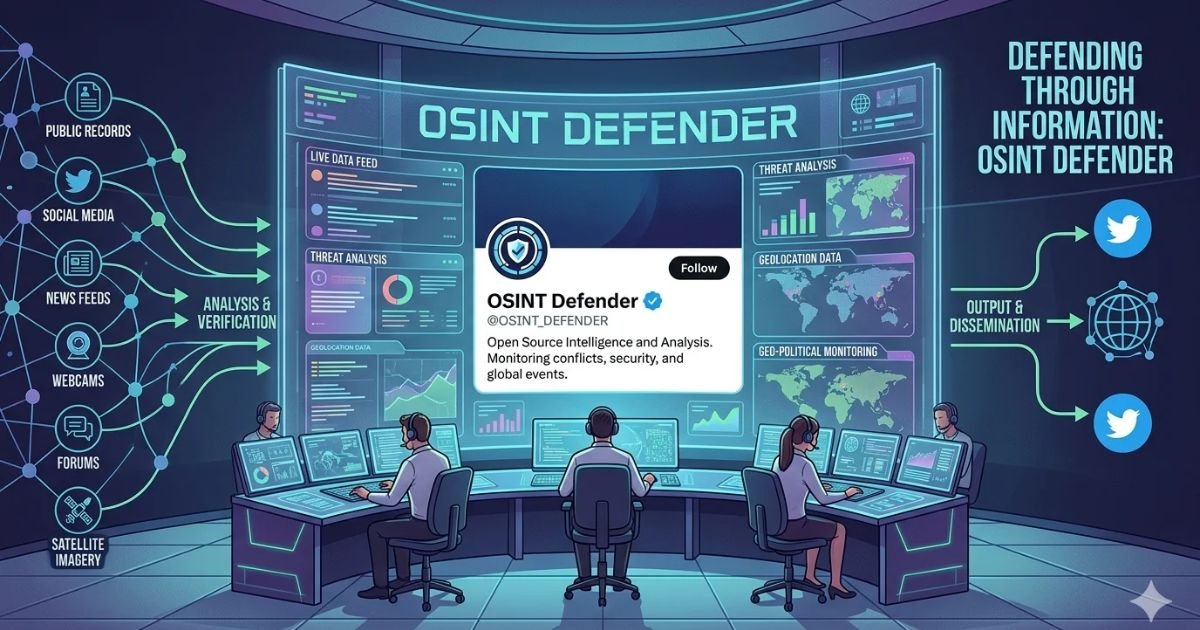
OSINT Defender has become a name many people see when big world events start moving fast online. From war updates to breaking security news, this account often appears in front of millions of readers within minutes. That is why so many people now want to know what it is, how it works, and whether its posts can be trusted. In a time when social media spreads information faster than ever, OSINT Defender stands out as a powerful example of how open source intelligence shapes what people see, believe, and share.
What OSINT Defender Means in Today’s News Space
OSINT Defender has become a name many people now notice when a major world event begins to unfold online. In simple words, it is known as a high visibility social media account that shares fast updates about wars, military activity, geopolitics, and breaking conflict news. Its public profile describes itself as an open source intelligence monitor focused on Europe and conflicts around the world, and the account has grown to a very large audience on X and other platforms. Public reporting and its own profile show that its appeal comes from speed, strong visuals, and constant posting during big international events. That matters because modern readers often discover world news through social feeds before they ever open a newspaper homepage. In that sense, OSINT Defender is not just one account. It is part of a bigger change in how people now consume urgent information online.
Why So Many People Follow OSINT Defender
A large number of people follow OSINT Defender because it gives updates in a style that feels immediate, simple, and emotionally charged. When a conflict is active, many readers do not want to wait for long reports, expert panels, or next day summaries. They want short posts, maps, clips, and quick explanations. Accounts like this meet that need. They turn complex military or political stories into short messages that are easy to scan on a phone. This is one reason the account has drawn millions of followers on X and a large audience on Instagram as well. For many users, the attraction is not perfect detail. It is the feeling of being informed in real time. That is powerful in a digital age where attention is short and people want updates the moment something happens, even before the full facts are settled.

How OSINT Defender Fits Into the Bigger OSINT World
To understand OSINT Defender properly, it helps to understand what OSINT really means. Open source intelligence is the process of gathering and analyzing publicly available information to answer questions, assess threats, or support decisions. Governments, journalists, researchers, and security teams all use this idea in different ways. Official and private sector sources describe OSINT as information drawn from public records, websites, social media, news sources, and other open materials, then turned into useful intelligence through analysis. That last part matters a lot. Raw information is not the same thing as verified intelligence. The strongest OSINT work usually depends on patience, cross checking, context, and evidence. So when people look at OSINT Defender, the important question is not only whether it posts fast. The real question is whether the account consistently turns public information into trustworthy insight with enough care and verification.
What Makes Conflict Updates Spread So Fast
The reason conflict accounts can rise so quickly is rooted in how social media platforms reward speed, emotion, and constant engagement. During tense global moments, users search for dramatic updates, maps, troop movement claims, explosions, and official reactions. The accounts that post first often gain the most reach, even if later corrections tell a fuller story. This creates a strong pressure to move fast. In that environment, OSINT Defender benefits from a format that feels direct and urgent. A short post with a bold claim can travel farther than a careful report filled with caution. This does not only apply to one account. It is part of a wider media system where posts that sound certain and urgent often beat slower, more careful reporting in the first wave of attention. That is why readers should understand the platform logic behind viral conflict news, not just the name attached to it.
The Main Strengths People See in OSINT Defender
Supporters of OSINT Defender usually point to three main strengths. First, the account is active at the exact moment interest peaks. Second, it presents updates in clear language that many non experts can understand. Third, it makes global security topics feel accessible to regular readers who may never read a defense journal or intelligence paper. In a confusing information environment, that kind of fast translation has real value. It can help people notice a developing event, understand why a region matters, or follow a story across several days instead of seeing one headline and moving on. Even critics often admit that these high speed OSINT style accounts have changed how public audiences engage with war and crisis reporting. They have made open source monitoring feel mainstream. That is a major cultural shift, because intelligence style analysis was once seen as a niche area mostly followed by specialists.
The Risks and Criticism Around OSINT Defender
At the same time, OSINT Defender also sits inside a serious debate about trust, bias, and accuracy. Critics argue that some popular OSINT themed accounts can blur the line between open source analysis, reposting, framing, and propaganda. A 2025 analysis in The New Arab said that high profile OSINT accounts, including OSINT Defender, have played a role in spreading disputed or misleading claims in Middle East coverage. Other public investigations have also raised questions about narrative bias and the danger of presenting uncertain claims with too much confidence. This does not mean every post is wrong. It means the audience should treat fast conflict content with caution, especially when events are still unfolding. In crisis reporting, even one wrong image, wrong location, or wrong conclusion can shape public opinion very quickly. That is why criticism around OSINT Defender is not a minor side issue. It goes to the heart of what public trust should look like online.
How Readers Should Verify Posts Before Trusting Them
The smartest way to read OSINT Defender is not with blind trust or blind rejection. It is with a verification mindset. Readers should compare major claims with established newsrooms, official statements, satellite imagery analysis, and other respected OSINT researchers before accepting a post as fact. They should also watch for emotional wording, missing context, and claims that appear too polished too early in a fast moving story. Good OSINT work is usually transparent about uncertainty. It explains what is known, what is not known, and what still needs confirmation. That is true in government use, cybersecurity use, and investigative work more broadly. If a post offers a dramatic conclusion without clear evidence, readers should slow down. The best habit is simple. Treat rapid posts as signals to investigate further, not as the final word. That one habit can protect people from being pulled into errors, rumor cycles, or agenda driven framing.
Why OSINT Defender Reflects a Bigger Media Shift
What makes OSINT Defender especially interesting is that it reflects a deeper change in journalism, security culture, and audience behavior. Years ago, many people waited for newspapers, TV anchors, or official briefings to explain a conflict. Now millions of users first learn about an attack, escalation, or military move from social accounts that mix monitoring, commentary, screenshots, and reposted evidence. This has both good and bad sides. The good side is that public information can move faster and become more accessible. The bad side is that authority can become confused with visibility. A post that looks confident may not be more reliable than a slower expert source. That larger media shift explains why accounts like OSINT Defender matter so much. They are not only sharing updates. They are reshaping who gets treated like an information gatekeeper during moments of fear, confusion, and high public attention.
The Future of OSINT Defender and Similar Accounts
The future of OSINT Defender will likely depend on one central issue, credibility under pressure. Large audiences can be built through speed, but long term influence depends on trust. As more people learn about OSINT, they will become more demanding about evidence, sourcing, and correction practices. At the same time, platforms will keep rewarding rapid content, which means the pressure to be first will not disappear. This creates a real test for accounts in this space. The ones that combine speed with careful verification may keep growing. The ones that rely too much on drama, narrative framing, or weak sourcing may face more criticism over time. More broadly, OSINT itself will remain important in cybersecurity, defense, journalism, and digital investigations because public data has become central to modern analysis. So the real future question is not whether these accounts will survive. It is whether they will mature into more responsible public intelligence voices.
Conclusion
OSINT Defender stands at the crossroads of speed, influence, and modern open source reporting. It shows how one account can become a major information stop for readers trying to understand conflict in real time. It also shows the danger of trusting fast content too easily. In today’s online world, open source intelligence is valuable, but only when it is handled with care, context, and proof. That is the key lesson behind the rise of OSINT Defender. People are hungry for clear updates, especially during global crises. Yet speed alone is never enough. Smart readers must balance curiosity with caution. The strongest way to use accounts like this is to see them as a starting point, not the finish line. When readers combine rapid updates with verification and patience, they gain something much more useful than noise. They gain a clearer and more responsible understanding of the world.
FAQs
What is OSINT Defender?
OSINT Defender is a high profile social media account known for posting rapid updates about global conflicts, military events, and geopolitical developments based on publicly available information.
Is OSINT Defender an official government source?
No public profile reviewed here presents OSINT Defender as an official government source. It presents itself as an open source intelligence monitor on social media.
Why is OSINT Defender popular?
It is popular because it offers fast, short, easy to follow updates during major breaking events, which matches how many people now consume news online.
Can OSINT Defender always be trusted?
No single fast moving source should be trusted without checking other evidence. Readers should compare claims with established reporting and transparent verification.
What is the biggest lesson from OSINT Defender?
The biggest lesson is that speed can attract attention, but credibility comes from evidence, context, and careful verification.