
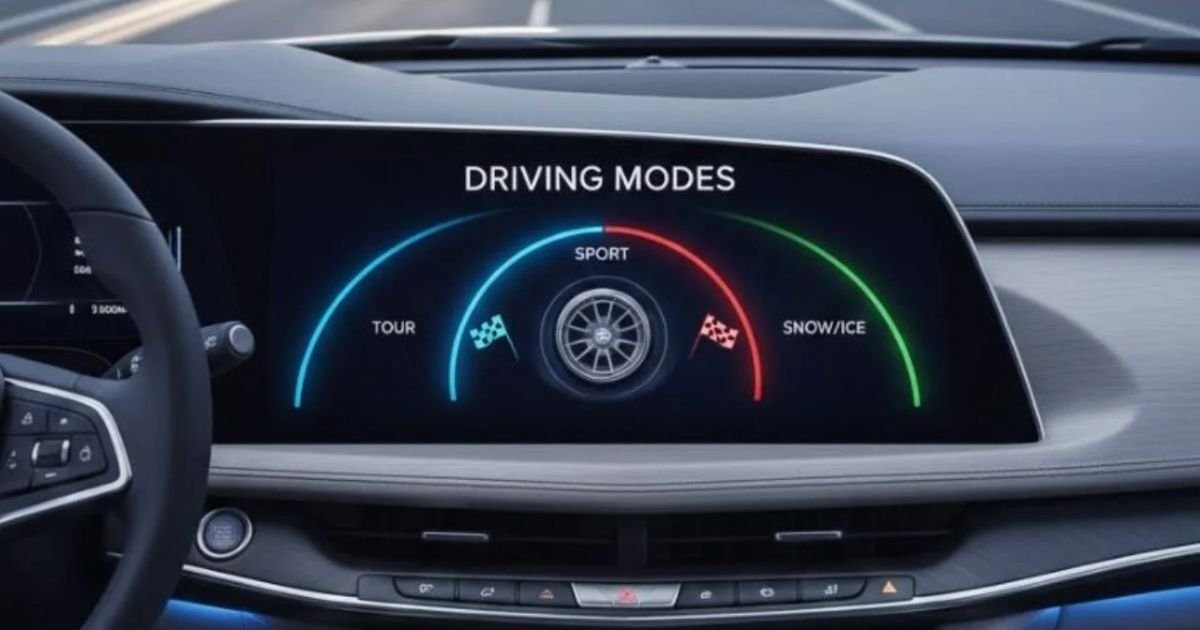
Electric cars feel simple on the surface. You charge them, drive them, and watch the miles go down. But once people start using an EV like the Cadillac LYRIQ, a smart question arises quickly: Do the driving modes in the Cadillac LYRIQ offer different ranges or battery usage? The honest answer is yes, but not in the way many drivers first imagine. The LYRIQ does not switch to a larger or smaller battery when you switch modes. Its battery pack stays the same. What changes is how the SUV uses that stored energy through throttle tuning, responsiveness, traction settings, and regenerative behavior. That means the mode you choose can affect real-world efficiency and range, even though it does not change the battery’s actual size.
This matters because the LYRIQ is not a one-size-fits-all EV. Cadillac offers it with a 102 kWh rated battery, and for 2025 models, the official range varies by setup. Rear wheel drive models are listed at 326 miles of EPA-estimated range, while dual motor all wheel drive versions are listed at 319 miles in one configuration and 303 miles in another. Cadillac also says regenerative braking features, such as Regen on Demand and One-Pedal Driving, can turn vehicle momentum back into electricity stored in the battery pack for future use. So while drive modes are not magic range buttons, they still shape how efficiently that energy is spent or recovered on the road.
What Cadillac says the LYRIQ driving modes actually do
Cadillac’s quick guide explains the system. Drive Mode automatically adjusts vehicle systems based on preferences, weather, and road conditions. The guide lists Tour for a smooth ride, Sport for responsiveness, Snow/Ice for snowy roads, and My Mode for personalizing acceleration, braking, steering, motor sound, and other systems. Importantly, Cadillac does not claim each mode changes battery capacity or range. Instead, the modes change how the vehicle behaves. Put simply, the battery stays the same; only the LYRIQ’s response to your right foot and to road conditions changes.
That is why the best answer to the driving modes in the Cadillac Lyriq is to offer different battery usage ranges. The modes do not officially come with separate EPA range labels, but they can still significantly affect real-world battery usage. A smooth, gentle mode usually improves efficiency because the car asks for power more calmly. A sharper and more aggressive mode can use more energy because it encourages stronger acceleration and faster response. A traction-focused mode for snow may also reduce efficiency in some situations, as it aims to keep the car stable and safe rather than maximizing miles per charge. That difference may be small on a short trip, but over many miles it can become noticeable.
The battery does not change, but energy use can
The LYRIQ’s battery pack has a 102 kWh rated energy capacity. That number stays the same in any drive mode. Think of it like a water tank: the size stays constant, but the flow rate changes. Drive modes mostly affect how quickly the vehicle draws energy on the road. Strong launches, hard acceleration, frequent bursts of speed, and high performance usually use more energy than steady driving.
This is also why many EV owners confuse rated range with lived range. Official range figures are tied to specific test setups, vehicle configurations, and equipment. Cadillac’s 2025 materials show that LYRIQ’s range, even in drive modes, varies by drivetrain and equipment. Rear Wheel Drive has the highest listed range. Some All Wheel Drive versions have a lower range. Cadillac’s brochure also shows that larger 22-inch wheels with low-profile tires are available, while other versions use 20-inch wheels. Bigger wheels and lower-profile tire packages often go hand in hand with a style and performance focus, and they can also affect efficiency. So the mode alone is never the whole story. The total range picture depends on the version you buy and how you drive it.
Tour mode is usually the safest choice for the best everyday efficiency.
Tour mode is the LYRIQ’s default setting, and Cadillac describes it as the mode to use for normal driving to ensure a smooth ride. That simple line tells you a lot. Smooth driving usually means gentler power delivery and fewer sudden demands on the battery. In everyday city traffic or steady suburban roads, that makes Tour the most likely mode to deliver the most balanced and efficient result for many drivers. It is not an official “eco mode” label, but it serves as a calm, sensible baseline.
For people asking, do the driving modes in the Cadillac Lyriq offer different ranges or battery usages? Tour mode is the easiest place to start. If you are trying to stretch the range, this is usually the setting that best supports that goal because it does not push the vehicle toward extra performance. Pair Tour mode with smooth acceleration, steady speeds, smart climate use, and regenerative braking, and you are giving the LYRIQ a strong chance to stay closer to its rated efficiency. On the other hand, if you drive the same route more aggressively, even the best mode cannot fully prevent your battery usage from increasing.
Sport mode can lower the real-world range.
Cadillac says Sport mode is for enhanced responsiveness. That means faster reaction to pedal input and a more energetic feel. Drivers who like a quick launch or a more lively SUV may enjoy it, but a sharper response usually means you are more likely to ask the battery for high output. EVs can deliver power instantly, and that instant punch is fun. It is also one of the easiest ways to drain energy faster.
So yes, Sport mode can reduce real-world range even though Cadillac does not publish a separate “Sport mode range” number. The reason is behavior, not hidden battery loss. The LYRIQ is simply using its available energy more aggressively. In a mixed commute, the drop may not be dramatic if you still drive gently. But if Sport mode leads to frequent, fast takeoffs, harder passing, and more rapid speed changes, the effect on battery usage becomes clear. In plain words, Sport mode does not drain the battery, but it can make it empty faster.
Snow and Ice mode helps control, not maximum miles.
Cadillac says Snow/Ice mode is for enhanced acceleration on snowy roads. That does not mean faster driving. It means the vehicle adjusts its response to help prevent wheel slip and improve control on slick roads. Safety comes first here. The LYRIQ is tuning the system to handle poor traction rather than to deliver the best possible miles per charge.
In winter, range can already suffer because cold batteries, cabin heating, and road conditions all work against efficiency. Cadillac also notes that regenerative braking may be limited when the propulsion battery is near full charge or when it is cold. That is a big clue for winter driving. Even if Snow/Ice mode is the right and safest setting, the season itself can reduce efficiency before the mode even comes into play. So when people ask whether drive modes affect range, the real answer is often tied to the whole environment. Snow/Ice mode may use energy differently, but cold weather and slippery roads are usually the bigger reasons the range drops.
My Mode depends on what you choose.
My Mode is one of the most interesting features because Cadillac says it lets you personalize acceleration feel, brake feel, steering, motor sound, and other systems. This means there is no single My Mode battery result. A comfort-focused setup in My Mode may behave more like Tour. A performance leaning setup may feel closer to Sport. Because the mode is customizable, its effect on battery usage depends on the choices the driver makes and how they use the mode.
That makes My Mode flexible, but it also makes it harder to answer with one simple number. If a driver creates a setup that encourages sharper throttle response and then drives hard every day, efficiency will likely fall. If the driver builds a calmer setup and maintains a smooth style, battery use may remain closer to Tour levels. So, when someone searches, do the driving modes in the Cadillac Lyriq offer different ranges or battery usages? My Mode is the clearest example that the LYRIQ changes energy use through behavior and tuning, not through battery size.
Regenerative braking can help recover some energy.
Cadillac highlights Regen on Demand and One-Pedal Driving as important LYRIQ efficiency features. The company says both systems convert the vehicle’s forward momentum into electricity stored in the battery pack for future use. In the quick guide, Cadillac also says Regen on Demand regenerates some energy from the vehicle’s momentum and stores it in the propulsion battery. That means part of your real-world range is not only about how much energy you use, but also about how much you recover while slowing down.
Driving style strongly influences EV efficiency. Planning ahead and using regenerative braking wisely can boost range. Cadillac adds that regen is limited when the battery is cold or nearly full. While regen helps, it is not limitless—a useful tool when conditions are right.
Other LYRIQ factors that can matter more than drive mode
Drive mode is important, but sometimes it is not the biggest factor in range. Cadillac’s own product details show that a 2025 Rear Wheel Drive LYRIQ can reach 326 miles, while All Wheel Drive versions are listed at 319 or 303 miles, depending on configuration. That means drivetrain choice alone can create a bigger shift than simply changing the screen from Tour to Sport for one trip.
Wheel and tire setup can matter too. Cadillac lists 20-inch wheels on some versions and available 22-inch wheels with low-profile tires on others. Bigger wheels can look great, but efficiency-minded buyers usually pay attention to them because vehicle equipment affects rolling resistance, weight, and aerodynamic behavior. Add in outside temperature, highway speed, hills, cargo load, and cabin climate use, and it becomes clear that range is shaped by a full mix of factors. So the smartest takeaway is not to obsess over mode alone. It is to think of mode as one tool inside a bigger efficiency picture.
Final answer
So, do the driving modes in the Cadillac Lyriq offer different ranges or battery usages? Yes, they can change real-world battery usage and the distance you get from a charge, but they do not change the actual battery pack or give the vehicle a new official battery size. Tour is the mode most likely to support smooth everyday efficiency. Sport can make the LYRIQ feel quicker and more fun, but often at the cost of higher energy use. Snow/Ice is built for traction and control, not for chasing the longest range. My Mode can land somewhere in between, depending on how you set it up.
The most accurate way to think about it is simple. The LYRIQ always uses the same battery, but each mode determines how it’s used. That is why two drivers in the same Cadillac LYRIQ can finish the same week with very different efficiency results. The best range usually comes from a calm mode, smooth inputs, smart use of regenerative braking, and a setup that favors efficiency over performance. So the answer is not just about the software setting. It is about the full driving habit behind that setting.
FAQs
Do the driving modes in the Cadillac Lyriq offer different ranges or battery usages?
Yes, in real driving, they can. The modes change how the LYRIQ responds and uses energy, even though the battery pack itself stays the same size.
Which LYRIQ mode is best for range?
Tour mode is usually the best starting point for balanced efficiency because Cadillac describes it as the normal, smooth driving mode.
Does Sport mode drain the battery faster?
It can often be used in the real world because Cadillac says Sport is for enhanced responsiveness, and sharper response usually leads to higher energy demand.
Does Snow or Ice mode save energy?
Not usually as a main goal. Snow/Ice mode is designed to improve control on slippery roads. In winter, cold weather itself can also reduce efficiency and limit regenerative braking.
Does regenerative braking increase LYRIQ range?
It can help recover some energy. Cadillac says Regen on Demand and One-Pedal Driving convert vehicle momentum into electricity that is stored in the battery for future use.